Case study · ATLR Paris · August 2026
Less spend, +38% ROAS: how a smarter product feed revived Google Shopping
- +38%ROAS
- -14%ad spend
- -20%cost per acquisition
- 1.8×impression share
Background
How can an optimized product feed improve Google Shopping performance without increasing ad spend?
ATLR Paris is a multibrand designer children’s fashion retailer operating on Shopify, primarily targeting the US market. With a diverse catalog spanning clothing, footwear, accessories, toys and books, Google Shopping is the brand’s main paid acquisition channel on Google, managed by ADIGI360.
In spring 2026, the Shopping campaign was spending a large share of its budget on products that were not selling. The feed came straight from Shopify with no rework: approximate categories, poorly optimized titles and outdated labels from 2022 still active. This created three problems:
- Wasted budget on toys: between February and early June, the toys category absorbed 15% of spend ($984) for $281 in sales, a ROAS of 0.3.
- Low visibility on the right searches: the campaign captured only 17% of available impressions and lost around 60% of impressions due to ad rank.
- Declining profitability: weekly ROAS fell to between 1.2 and 2.6 in April and May.
The campaign structure, a single “all products” group, was not the issue: the quality of the feed determined which products Google put forward.
Strategy
Replacing Shopify’s native feed with an optimized DataFeedWatch feed, without changing the campaign structure.
The objective was to help Google’s algorithm prioritize higher-performing products while reducing wasted spend on less profitable categories, without increasing the advertising budget. The project ran in three phases:
- April 2026, scoping: a DataFeedWatch demo on April 13, followed by a setup session on April 29.
- May 2026, feed build: the new feed was prepared in DataFeedWatch from the Shopify catalog.
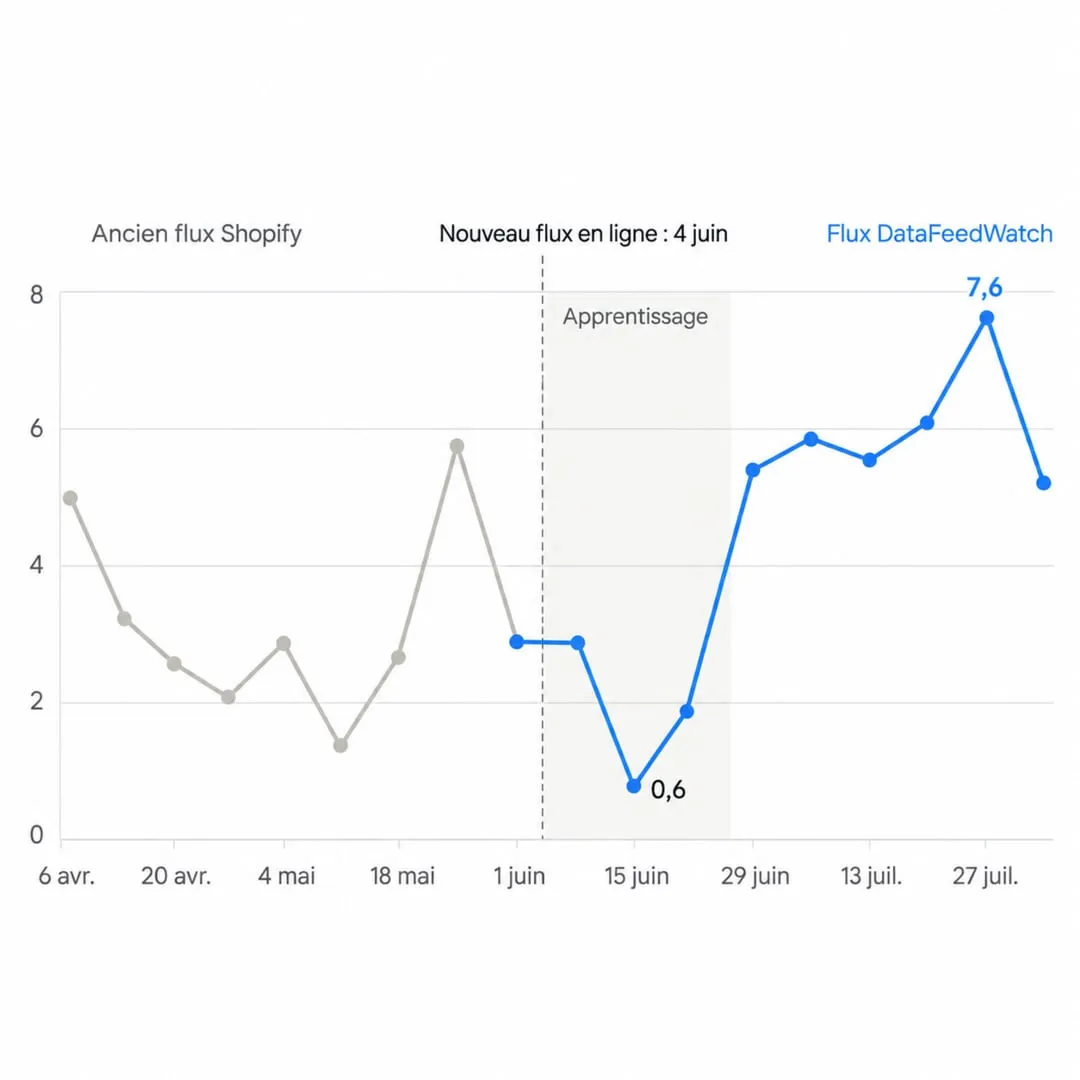
- June 4, 2026, switch-over: the new feed replaced the old one in the same Merchant Center, with the same product IDs, so the campaign kept its performance history.
The new feed introduced two concrete changes. First, a more granular classification: broad categories such as “shoes” or “toys” became “sneakers”, “baby & toddler boots” or “stuffed animals”, helping Google match each product to the right search queries. Second, a cleaner feed: legacy labels inherited from 2022, such as “google-summersale2022”, were removed.
Results
Higher ROAS, lower costs and more visibility, while spending less.
After a three-week learning period, weekly ROAS settled between 5 and 7.6, compared with 1.2 to 3 in most weeks of April and May. Comparing the eight weeks before and after implementation:
- ROAS increased by 38%, from 2.80 to 3.86, while advertising spend decreased by 14%.
- Conversion value increased by 18% despite the lower investment.
- Cost per acquisition dropped by 20%, from $38.66 to $30.80.
- Average order value rose by 10%, from $108 to $119.
- Shopping impression share rose 1.8 times, from 17% to 32%, with a lower budget.
The gains came mainly from better budget allocation rather than higher spend. Toys’ share of advertising spend dropped from 15% to 3% (their ROAS stayed at 0.3), allowing more budget to flow toward higher-performing categories such as apparel and accessories, where ROAS increased from 5.1 to 5.9.
After accounting for seasonal trends, the estimated incremental ROAS improvement was approximately 28%. Over the same dates in 2025, the account’s Shopping ROAS had risen by only 7%, so the net gain attributable to the feed is about 1.38 / 1.07.
Methodology: results compare two eight-week periods of the same Google Shopping campaign, April 8 to June 3, 2026 (before) and June 4 to July 30, 2026 (after). The window deliberately ends before the August flash sale and the September budget changes, which would have inflated the results. Source: ATLR Paris Google Ads account, campaign reports and Shopping reports by product category. Amounts in US dollars.
Conclusion
On Google Shopping, the product feed is the targeting.
Google Shopping performance depends on more than bidding strategies and advertising budgets: improving the feed had more impact than adding budget. For ATLR Paris, describing products more accurately shifted spend away from toys that were not selling and toward clothing and footwear that convert, delivering stronger returns, lower acquisition costs and greater visibility while spending less. Performance stabilized at a higher level after two to three weeks of learning.
The work continues. The next steps are to complete the product categories that are still empty and to segment the campaign by product family for finer bid control.